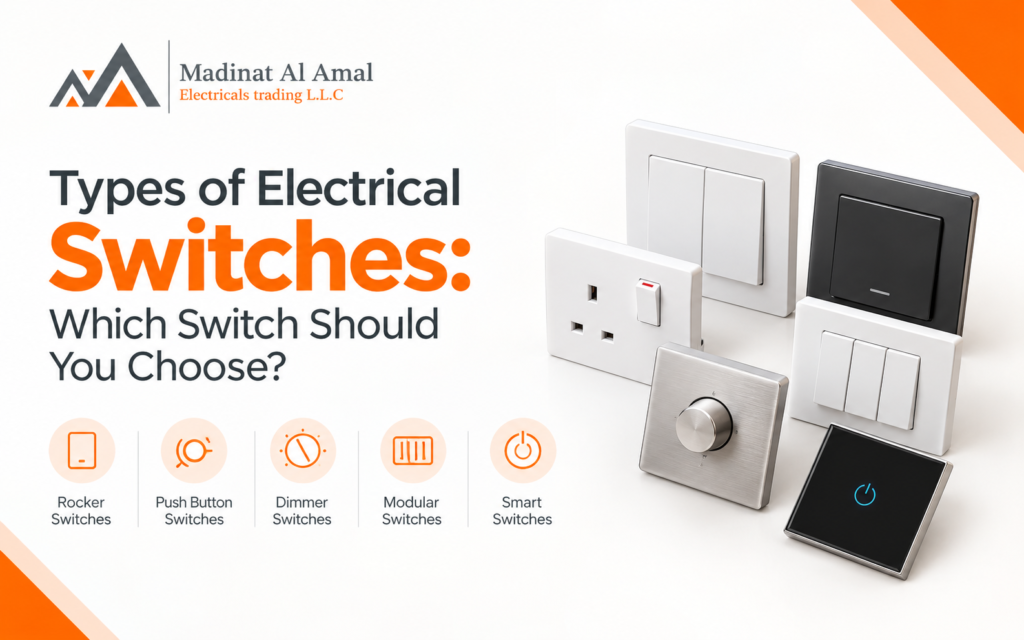
Electrical switches may look like simple components, but choosing the right one involves more than selecting a design or finish. Different switches are designed for different applications, control arrangements, electrical loads, and installation requirements.
From a basic switch that controls one light to dimmer and smart switches with additional functionality, understanding the types of electrical switches available can help you select a solution that fits your space and electrical system.
For homeowners, contractors, interior designers, and project managers, the right switch should balance functionality, compatibility, safety, appearance, and long-term usability.
What Is an Electrical Switch?
An electrical switch is a device used to control the flow of electricity within a circuit. Depending on its design and application, a switch can turn a light or appliance on and off, control the same light from multiple locations, adjust lighting levels, or provide smart control.
The switch you need depends largely on what you want to control and how you want to control it.
For example, a bedroom with one light controlled from one location may only require a basic one-way switch. A staircase where the same light needs to be controlled from two locations requires a different switching arrangement.
Common Types of Electrical Switches
There are several different types of electrical switches available for residential, commercial, and other applications. Some of the most common options include the following.
1. One-Way or Single-Pole Switch
A one-way switch is one of the simplest and most commonly used switch types. It allows a light or electrical fixture to be turned on or off from one location.
It can be suitable for applications such as:
- Bedrooms
- Bathrooms
- Small offices
- Storage rooms
- Individual lighting points
If one switch controls one light from one location, a one-way switch is generally the basic configuration to consider.
2. Two-Way Switch
A two-way switching arrangement allows the same light to be controlled from two different locations.
This can be useful in areas such as:
- Staircases
- Long corridors
- Large bedrooms
- Hallways
- Rooms with two entrances
For example, you could switch on a staircase light from the bottom of the stairs and turn it off from the upper level.
The terminology can vary between regions, so it is useful to explain the intended application to an electrician or supplier before purchasing the switch.
3. Intermediate Switch
An intermediate switch is used when a lighting circuit needs to be controlled from three or more locations.
It can be useful for larger spaces or long passageways where controlling a light from only two locations is not sufficient.
For example, a long corridor may have switches at multiple points so that occupants do not have to walk to one end of the corridor to operate the lighting.
4. Double-Pole Switch
A double-pole switch can simultaneously switch two conductors and is commonly associated with higher-power or dedicated electrical circuits.
These switches can be used for applications involving larger electrical loads, depending on the circuit design and applicable electrical requirements.
Because electrical load and circuit configuration matter, a double-pole switch should not simply be selected based on appearance. The electrical requirements of the installation should be checked first.
5. Dimmer Switch
A dimmer switch allows the brightness of compatible lighting to be adjusted rather than simply switching the lights on or off.
This can be useful in:
- Living rooms
- Bedrooms
- Dining areas
- Hospitality spaces
- Restaurants
- Meeting rooms
Before choosing a dimmer, check that the lighting source is compatible with dimming and that the dimmer is suitable for the intended application. Compatibility between the dimmer and LED lamps is particularly important because an unsuitable combination can result in flickering, buzzing, or limited dimming performance.
6. Push-Button Switch
Push-button switches operate when pressed. Depending on the application, they may either maintain a switching state or provide momentary contact.
They are commonly associated with applications such as:
- Doorbells
- Control panels
- Certain lighting controls
- Special-purpose electrical systems
A push-button design can also be incorporated into modern modular switch ranges.
7. Rocker Switch
Rocker switches use a rocking mechanism to operate the electrical circuit.
They are available in various designs and can be used for lighting and other electrical applications. Their straightforward operation and clean appearance make them a common option in contemporary interiors.
8. Smart Switch
Smart switches add connectivity and automation features to conventional electrical control.
Depending on the product, a smart switch may allow users to control compatible lighting through:
- A mobile application
- Voice assistants
- Timers
- Automation routines
- Remote access
However, smart switches have specific installation and compatibility requirements. The existing wiring, connected load, smart-home ecosystem, and manufacturer’s specifications should be checked before selecting one.
9. Motion or Sensor Switch
A sensor switch can automatically control lighting when movement or occupancy is detected, depending on the type of sensor.
These switches can be useful in areas such as:
- Corridors
- Washrooms
- Staircases
- Utility areas
- Offices
- Storage spaces
They can provide convenience by reducing the need for manual switching and may help avoid lights being left on unnecessarily.
Madinat Al Amal’s product range also includes motion-sensor solutions alongside its switches and sockets.
Choose the Right Electrical Switch for Your Project
Need help choosing the right switch type, design, or electrical specifications? Talk to Madinat Al Amal for suitable electrical switch options in Dubai.
How to Choose the Right Electrical Switch
With so many electrical switch types available, how do you know which one is suitable?
Instead of choosing based only on appearance, consider these factors.
1. Consider the Application
Start by identifying what the switch needs to control.
Ask:
- Is it for a light?
- Is it for a fan or another appliance?
- Does the circuit require control from one location or multiple locations?
- Do you need simple on/off control?
- Do you need dimming or automation?
The answer will help narrow down the appropriate switch configuration.
2. Check the Electrical Requirements
The switch must be compatible with the electrical circuit and connected load.
Consider relevant factors such as:
- Voltage
- Current rating
- Load type
- Circuit configuration
- Manufacturer specifications
- Applicable local standards
For commercial and industrial installations, electrical specifications should be reviewed by the relevant qualified professionals before products are approved.
3. Think About the Installation Environment
The location can influence which switch is appropriate.
A switch installed in a normal indoor room may have different requirements from one used in an area exposed to moisture, dust, heat, or other environmental conditions.
For commercial projects, environmental conditions and applicable protection requirements should be considered during product selection.
4. Check Compatibility
Compatibility is particularly important when selecting modular or smart electrical products.
Before ordering, check:
- Switch module
- Plate
- Frame
- Back box
- Mounting arrangement
- Wiring space
- Accessories
- Product range
Components that appear similar are not necessarily interchangeable.
5. Consider Design and Finish
Function comes first, but switches are also visible parts of an interior.
Modern modular electrical switches are available in a variety of colours, finishes and styles. Depending on the range, options may include white, black, metallic, brass and other finishes.
For residential and commercial interiors, the switch design can be coordinated with the overall décor.
Madinat Al Amal’s current product range includes multiple switch and socket designs and finishes from established electrical brands.
6. Think About Future Requirements
For a new construction or renovation project, consider whether additional functionality may be required later.
For example, you may want to plan for:
- Smart-home controls
- Additional lighting points
- Dimming
- Sensor-based lighting
- Consistent replacement products
- Expansion of the electrical installation
Planning these requirements early can make procurement and installation easier.
Electrical Switches: Quick Comparison
Switch Type | Typical Use | Control |
One-way / Single-pole | Basic lighting | One location |
Two-way | Staircases, corridors | Two locations |
Intermediate | Larger spaces | Three or more locations |
Double-pole | Selected higher-power circuits | Two conductors simultaneously |
Dimmer | Adjustable lighting | Brightness + on/off |
Push-button | Doorbells and special controls | Press operation |
Smart switch | Connected lighting | App/automation/voice, depending on model |
Sensor switch | Automated lighting | Motion/occupancy detection |
The exact suitability of each switch depends on the electrical design, product specifications, and installation requirements.
Should You Choose Modular Switches?
Modular switches can be useful when you want flexibility in designing an electrical installation. Different functions can be incorporated into a common plate or frame, allowing lighting controls, sockets, regulators, and other modules to be arranged according to the project’s requirements.
They can also offer more choices in terms of finishes and design.
For a project requiring several electrical accessories, you can explore electrical switches and sockets from Madinat Al Amal Electricals, which supplies switch and socket ranges from brands including Legrand and Schneider Electric.
Find the Right Electrical Switch Solution
Explore electrical switch options designed for different residential, commercial, and industrial applications, control requirements, and installation needs.
Common Mistakes to Avoid When Choosing Switches
Choosing a switch based only on price or appearance can create problems later.
Some common mistakes include:
Choosing the Wrong Switch Configuration
A one-way switch cannot simply replace every two-way or intermediate switching arrangement. The number of control locations needs to be established first.
Ignoring Load Requirements
The switch must be appropriate for the electrical load and circuit.
Overlooking Compatibility
For modular systems, confirm that the switch, plate, frame, and associated components belong to compatible product ranges.
Selecting Only by Appearance
A stylish finish is useful, but technical suitability should come first.
Buying Without Checking Availability
For larger projects, consistent availability can matter when future replacements are needed. It is worth considering whether the same product range and finish can be sourced later.
Why Choosing the Right Supplier Matters
The supplier is an important part of the product-selection process, particularly for contractors, MEP companies, interior designers, and large projects.
A reliable supplier can help with product availability, specifications, brand selection, project quantities, and technical requirements.
Madinat Al Amal Electricals supplies electrical products for residential, commercial, and industrial projects across the UAE, with product categories including switches and sockets, floor boxes, data cables, EV charging stations, and other electrical solutions.
For larger requirements, the company also states that it provides bulk electrical supply and technical assistance for project installations across the UAE.
Planning an Electrical Switch Installation?
Get the right switch solution for your project requirements. Contact Madinat Al Amal for electrical switch options in Dubai.
Final Thoughts
Choosing between the various types of electrical switches becomes much easier when you start with the function rather than the appearance.
Think about where the switch will be installed, what it will control, how many locations need to operate the circuit, the electrical load, compatibility requirements, and the environment in which it will be used.
For a simple lighting point, a basic one-way switch may be sufficient. For multiple control points, you may need a two-way or intermediate arrangement. If you want adjustable lighting, consider a compatible dimmer, while smart or sensor switches can provide additional control and automation features.
For projects in Dubai and across the UAE, reviewing the technical requirements with an experienced electrical supplier can help you identify products that match your installation needs.
Simplify Your Electrical Switch Selection
From switch type and control requirements to electrical specifications and design, choose a switch that fits your project’s needs.
Frequently Asked Questions
What are the most common types of electrical switches?
Common options include one-way or single-pole switches, two-way switches, intermediate switches, double-pole switches, dimmers, push-button switches, smart switches, and sensor switches.
Which switch is commonly used for a single light?
A one-way or single-pole switch is commonly used when one switch controls a light from one location.
Which switch is used to control a light from two locations?
A two-way switching arrangement can be used when the same light needs to be controlled from two locations, such as the top and bottom of a staircase.
Are dimmer switches compatible with all LED lights?
No. The LED lamp and dimmer need to be compatible. Always check the manufacturer’s specifications before installation.
Are smart switches suitable for every electrical installation?
Not necessarily. Smart switches can have specific wiring, load, connectivity, and compatibility requirements. These should be checked before purchase and installation.
Where can I buy electrical switches in Dubai?
You can explore switch and socket options from Madinat Al Amal Electricals, which supplies electrical products from established brands for residential, commercial, and industrial applications across the UAE.
Need Electrical Switches in Dubai?
Discuss your project requirements with Madinat Al Amal and explore suitable floor box solutions for commercial installations.