Commercial lighting plays an important role in creating productive, comfortable, and energy-efficient environments. From offices and retail stores to warehouses, hotels, and industrial facilities, the right lighting system can improve visibility, support daily operations, and contribute to long-term energy savings.
LED technology has become a popular choice for commercial lighting because it offers high energy efficiency, a long operating life, and a wide range of lighting options. However, selecting the right LED lighting system involves more than choosing a fixture. Businesses must consider brightness, colour temperature, energy consumption, installation requirements, lighting distribution, and the specific needs of their premises.
For contractors, MEP companies, facility managers, developers, and procurement teams, understanding these factors makes it easier to specify suitable products for different projects.
In this guide, we explore the main types of commercial LED lighting, their applications, and the factors to consider when sourcing products from a reliable commercial LED lighting supplier in Dubai.
What Is Commercial LED Lighting?
Commercial LED lighting refers to lighting systems designed for business premises, public facilities, offices, retail environments, warehouses, and other professional spaces. These systems use light-emitting diodes (LEDs) to convert electrical energy into light.
Compared with many traditional lighting technologies, LED fixtures can offer lower energy consumption, a long service life, and flexible installation options. Their performance depends on the quality of the product, its design, operating conditions, and how effectively the lighting system is specified.
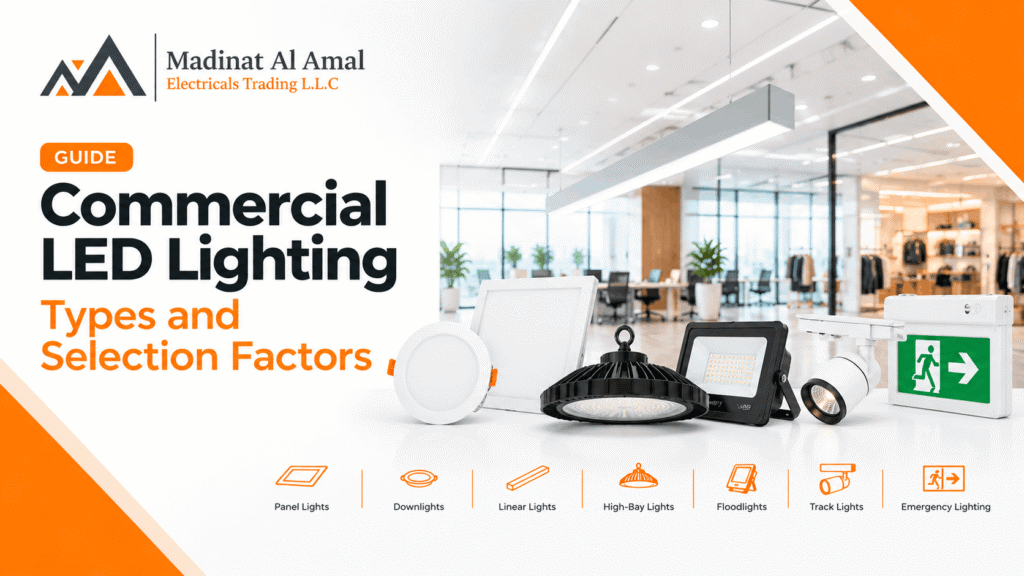
Commercial LED lighting solutions include panel lights, downlights, linear fixtures, high-bay lights, floodlights, track lights, and emergency lighting products.
Businesses can explore the electrical products offered by Madinat Al Amal when researching electrical requirements for commercial and professional projects.
Types of Commercial LED Lighting
Different commercial spaces require different lighting arrangements. The fixture type should be selected according to ceiling height, room layout, activity, illumination requirements, and installation conditions.
1. LED Panel Lights
LED panel lights provide broad, relatively uniform illumination and are commonly installed in offices, meeting rooms, educational facilities, and commercial interiors.
They are frequently used in suspended ceiling systems and can help create a clean, modern appearance.
Common applications:
- Corporate offices
- Conference and meeting rooms
- Schools and training centres
- Healthcare and administrative spaces
- Commercial interiors
When selecting LED panel lights, consider lumen output, glare control, colour temperature, dimensions, dimming compatibility, and the ceiling installation method.
2. LED Downlights
LED downlights are recessed or surface-mounted fixtures used to provide general or accent lighting. Their compact design makes them suitable for spaces where a discreet lighting appearance is preferred.
They are often used in reception areas, corridors, hotels, retail stores, restaurants, and commercial interiors.
Downlights are available in different beam angles, wattages, colour temperatures, and optical designs. Narrower beams can highlight specific features, while wider distributions may be more suitable for general illumination.
3. LED Linear Lights
LED linear lighting systems provide elongated illumination and can be installed individually or in continuous arrangements. They are commonly used in offices, corridors, retail spaces, and contemporary commercial interiors.
Linear fixtures can support uniform lighting across workstations and circulation areas when appropriately positioned.
Important selection factors include fixture length, lumen output, mounting method, glare performance, dimming options, and the intended lighting layout.
4. LED High-Bay Lights
LED high-bay lights are designed for spaces with high ceilings, where fixtures need to distribute light over large floor areas.
Typical applications include:
- Warehouses
- Manufacturing plants
- Distribution centres
- Industrial workshops
- Large storage facilities
When selecting high-bay fixtures, evaluate mounting height, beam angle, lumen output, glare, dust exposure, and operating temperature. A photometric lighting layout can help determine the appropriate number and positioning of fixtures.
5. LED Floodlights
LED floodlights provide broad illumination for outdoor areas and large open spaces. Depending on their design and rating, they can be used in parking areas, building exteriors, loading bays, yards, and selected industrial locations.
For outdoor applications, consider weather protection, corrosion resistance, mounting arrangements, beam distribution, and resistance to local environmental conditions.
In Dubai and other parts of the UAE, heat, dust, and direct sunlight can affect fixture performance. Check the manufacturer’s specified operating temperature and environmental ratings before installation.
6. LED Track Lights
LED track lighting uses fixtures mounted on a track system, allowing light direction and positioning to be adjusted according to the application.
Track lights are widely used in retail stores, showrooms, galleries, and display areas where products or architectural features need focused illumination.
The key selection factors include beam angle, colour rendering, track compatibility, wattage, and the desired visual effect.
7. LED Emergency Lighting
Emergency lighting helps provide illumination when normal power fails, supporting safe movement and evacuation where required.
Commercial buildings may require emergency luminaires, exit signs, or dedicated emergency lighting systems depending on the building’s use and applicable regulations.
Product selection should account for applicable safety standards, emergency duration, battery arrangements, testing requirements, and installation location.
Looking for Commercial LED Lighting in Dubai?
Planning an office, retail, warehouse, or industrial lighting project? Get in touch with Madinat Al Amal to enquire about commercial LED lighting products and availability.
Important Factors to Consider When Selecting Commercial LED Lighting
Choosing the right fixtures requires a combination of technical assessment and practical project planning.
1. Lumen Output and Brightness
Lumens measure the amount of visible light emitted by a source. Wattage measures electrical power consumption and does not directly indicate how much light a fixture produces.
When comparing commercial LED products, examine their lumen output and efficacy, expressed as lumens per watt.
The required output depends on the space, mounting height, surface reflectance, lighting layout, and the activities performed. A lighting design should establish the target illumination level rather than relying on wattage alone.
2. Colour Temperature
Correlated colour temperature (CCT), measured in kelvins (K), describes whether light appears warmer or cooler.
Colour temperature | General appearance | Common applications |
2700K–3000K | Warm white | Hospitality, lounges, selected reception areas |
3500K–4000K | Neutral white | Offices, retail environments, general commercial spaces |
5000K–6500K | Cool or daylight-like white | Selected warehouses, industrial tasks, utility areas |
These are general guidelines rather than strict rules. The most suitable colour temperature depends on the visual task, the desired atmosphere, and the building’s lighting design.
3. Colour Rendering Index (CRI)
The Colour Rendering Index indicates how accurately a light source reveals colours compared with a reference source under defined conditions.
A higher CRI can be important in retail displays, inspection areas, healthcare settings, and applications where colour differentiation matters.
For general commercial spaces, the required CRI should be determined by the intended use and applicable project specifications.
4. Energy Efficiency
Energy efficiency affects the electricity required to operate a lighting installation. Compare the fixture’s lumen output with its power consumption and consider how many operating hours the lights will be used each day.
For a simple estimate:
Annual energy consumption (kWh) = Total lighting power (kW) × Operating hours per year
For example, a lighting installation with a total load of 2 kW operating for 3,000 hours annually would consume approximately 6,000 kWh per year.
Actual savings from upgrading to LED lighting depend on the existing system, operating schedule, fixture performance, and lighting controls.
5. Lighting Distribution and Glare
A fixture’s beam angle and light distribution affect how illumination reaches the working surface.
A narrow beam may be appropriate for accent lighting, while a wider distribution may suit general illumination. In warehouses, the beam pattern must be considered alongside rack arrangements and aisle geometry.
Glare should also be assessed, particularly in offices, computer workstations, inspection areas, and other spaces where visual comfort is important.
6. IP Rating and Environmental Conditions
The Ingress Protection (IP) rating indicates the level of protection an enclosure provides against solid particles and water under specified test conditions.
For example, an indoor office may have different requirements from an outdoor loading bay or a dusty industrial facility.
Do not choose a fixture based on IP rating alone. Also check operating temperature, impact resistance, corrosion protection, chemical exposure, and any special installation requirements.
7. Installation and Maintenance
Before purchasing lighting fixtures, check the mounting method, ceiling type, dimensions, wiring arrangements, driver compatibility, and access requirements.
Consider maintenance access, replacement parts, warranty conditions, and the availability of compatible products. These factors can affect the total cost of ownership throughout the system’s operating life.
8. Lighting Controls
Occupancy sensors, daylight sensors, timers, and dimming systems can help reduce unnecessary energy consumption when selected and configured correctly.
Before choosing controlled fixtures, verify compatibility between the LED drivers, controls, wiring, and building management systems.
Choose the Right Commercial LED Lighting
Need help selecting the right LED lights, brightness, or colour temperature for your project? Contact Madinat Al Amal for suitable commercial LED lighting solutions in Dubai.
How to Calculate Commercial Lighting Requirements
Lighting requirements should be established according to the intended use of the space and the applicable project standards.
A preliminary estimate can be made using the lumen method:
Required lumens = Target illuminance (lux) × Floor area (m²)
For example, if a room measures 100 m² and the preliminary design target is 300 lux, the target illuminance multiplied by the floor area equals 30,000 lumens reaching the working plane.
This is not necessarily the total rated lumen output required from the fixtures. Designers must account for utilisation, maintenance factors, light distribution, mounting height, and other variables. A professional lighting calculation or photometric simulation is recommended for commercial projects.
Why Work With a Commercial LED Lighting Supplier in Dubai?
Choosing a reliable supplier is an important part of commercial lighting procurement. Contractors, MEP companies, developers, and facility managers often need to compare product specifications, confirm quantities, and coordinate delivery with project schedules.
A suitable supplier should be able to help customers identify relevant product options, review technical specifications, and understand product availability.
When requesting commercial LED lighting products, provide the application, installation location, required quantity, preferred specifications, mounting height, and any relevant environmental conditions. This information helps narrow the options to products that may suit the project.
Conclusion
Commercial LED lighting is an important consideration for businesses seeking suitable illumination, energy efficiency, and reliable performance across offices, retail spaces, warehouses, industrial facilities, and outdoor environments.
Selecting the right solution requires evaluating fixture types, lumen output, colour temperature, colour rendering, environmental protection, lighting controls, and installation requirements. A properly planned system can support visual comfort, operational efficiency, and long-term maintenance objectives.
If you are sourcing lighting for a commercial or industrial project, Madinat Al Amal can help you explore suitable electrical product options for your requirements. Whether you need LED lighting for offices, warehouses, retail spaces, or industrial facilities, our team can assist with your product enquiries.
Contact Madinat Al Amal to enquire about commercial LED lighting products, check availability, and discuss your project requirements.
Upgrade Your Commercial Lighting
Frequently Asked Questions
1. What is the best type of LED lighting for commercial buildings?
The best type depends on the application. LED panels and linear lights are commonly used in offices, high-bay fixtures in warehouses, track lights in retail stores, and suitable floodlights in outdoor areas.
2. How do I choose a commercial LED lighting supplier in Dubai?
Compare product specifications, energy efficiency, availability, warranty terms, technical information, and suitability for the installation environment. Provide the supplier with your project requirements before requesting recommendations.
3. What colour temperature is best for office LED lighting?
Neutral white lighting around 3500K–4000K is commonly considered for offices. The final choice should account for visual comfort, task requirements, interior finishes, and the overall lighting design.
4. Are LED lights suitable for warehouses?
Yes. LED high-bay and other industrially suitable fixtures are widely used in warehouses. Selection should consider ceiling height, rack layout, required illumination, glare, operating conditions, and maintenance access.
5. How can commercial LED lighting reduce energy costs?
LED fixtures can reduce electricity consumption when they replace less-efficient lighting while maintaining appropriate illumination. Occupancy sensors, daylight controls, and effective lighting design can provide additional savings where suitable.
Enquire About Commercial LED Lighting Solutions
Need reliable lighting products for your next project in Dubai? Speak with Madinat Al Amal about your LED lighting requirements, product specifications, and availability.