Industrial electrical systems often require connection solutions that can handle demanding operating conditions, higher loads, frequent use, and exposure to dust, moisture, heat, or mechanical stress. This is where industrial plugs and sockets become important. Unlike standard domestic plugs and sockets, industrial connection systems are designed for applications where durability, electrical performance, and environmental protection are important considerations.
Industrial plugs and sockets are commonly used in manufacturing facilities, workshops, warehouses, construction sites, commercial buildings, temporary installations, and other demanding environments. They are available in different current ratings, voltage configurations, pole arrangements, and protection levels to suit specific applications.
Choosing the right type requires more than simply matching a plug with a socket. Electrical load, voltage, current rating, frequency, number of poles, installation environment, ingress protection, and intended application should all be considered before selecting a product.
What Are Industrial Plugs and Sockets?
Industrial plugs and sockets are electrical connection devices designed to provide a secure and reliable connection between electrical equipment and a power supply.
An industrial plug is fitted to the cable connected to equipment, while the corresponding socket provides the connection point. Depending on the design, these products can be used for portable machinery, industrial equipment, distribution systems, temporary power installations, and other electrical applications.
Their construction is generally intended for environments where electrical equipment may experience more demanding conditions than those found in typical residential applications.
For example, a workshop may need power connections for welding equipment, machinery, compressors, or other electrical tools. A commercial facility may require connections for maintenance equipment or temporary power distribution. In such cases, selecting an appropriate industrial connection system can help ensure that the equipment is connected according to the requirements of the installation.
Why Are Industrial Plugs and Sockets Important?
Industrial environments can place additional demands on electrical connection points. Equipment may be moved frequently, connected and disconnected regularly, or operated in areas where dust, moisture, impact, or temperature changes are present.
Industrial plugs and sockets can offer several practical advantages when correctly selected for the application.
1. Designed for demanding environments
Industrial connection systems are available in robust constructions intended for commercial and industrial applications. The appropriate product can provide a more suitable connection solution where standard domestic products may not meet the requirements of the installation.
2. Different current and voltage options
Industrial electrical products are available in various current and voltage configurations. This allows contractors and electrical professionals to select products that correspond with the electrical characteristics of the equipment.
3. Secure connections
A suitable industrial plug and socket combination is designed to provide a stable electrical connection. Certain configurations also incorporate locking or interlocking mechanisms to help prevent accidental disconnection.
4. Environmental protection
Some industrial plugs and sockets are available with specific IP ratings. The appropriate rating can help protect the connection from the ingress of solid particles and water under the conditions for which the product is designed.
5. Suitable for different applications
From manufacturing facilities and workshops to construction sites and commercial projects, industrial connection products can be selected according to the requirements of the installation.
Choose the Right Industrial Plug and Socket
Need help selecting the right current rating, voltage, pole configuration, or IP-rated connection? Talk to Madinat Al Amal for suitable industrial plugs and sockets in Dubai.
What Does the Number of Poles Mean?
The number of poles is another important specification when choosing an industrial plug or socket.
Depending on the configuration, an industrial connection may incorporate:
- Phase conductors
- Neutral
- Protective earth
Different equipment and electrical systems require different arrangements. Therefore, the number of poles should match the requirements of the circuit and equipment.
Understanding the required pole configuration helps prevent selecting an incompatible connection.
Understanding IP Ratings
Environmental conditions are particularly important for industrial electrical connections.
An IP rating, or Ingress Protection rating, indicates the degree of protection provided by an enclosure against the ingress of solids and water under defined test conditions.
For example, products with higher levels of environmental protection may be considered for areas where dust or moisture is more likely to be present.
However, an IP rating should not be selected simply because a higher number sounds better. The required level of protection depends on the actual installation environment.
When selecting an industrial socket for a warehouse, outdoor installation, workshop, food-processing area, or construction environment, consider factors such as:
- Exposure to water
- Dust and particles
- Cleaning methods
- Temperature
- Mechanical impact
- Installation location
- Frequency of use
The product’s technical documentation should always be checked to understand exactly what its IP rating represents.
Where Are Industrial Plugs and Sockets Used?
Industrial connection products can be found across a wide range of sectors.
Manufacturing Facilities
Factories may use industrial connections for machinery, production equipment, maintenance tools, and temporary electrical systems.
Construction Sites
Construction environments often require temporary power connections for equipment and tools. Products selected for these environments may need to account for mechanical handling and environmental exposure.
Workshops
Workshops can use industrial sockets for power tools, compressors, machinery, and other equipment requiring dedicated electrical connections.
Warehouses
Warehouses may require electrical connections for maintenance equipment, material-handling systems, cleaning equipment, and other applications.
Commercial Buildings
Large commercial facilities can use industrial electrical connection products for maintenance systems, equipment rooms, temporary installations, and specialised equipment.
Events and Temporary Installations
Temporary electrical systems may require robust connection solutions that can be installed, disconnected, and repositioned according to project requirements.
Industrial Plugs and Sockets vs Standard Plugs and Sockets
Although both provide electrical connections, their intended applications can differ significantly.
Feature | Industrial Plugs and Sockets | Standard Domestic Plugs and Sockets |
Typical application | Industrial and commercial environments | Residential and general applications |
Construction | Often designed for demanding use | Generally designed for everyday indoor use |
Current options | Available across various industrial ratings | Usually intended for common household loads |
Environmental protection | Various IP-rated options available | Protection depends on product type |
Configuration | Multiple voltage, pole and current configurations | More standardised configurations |
Applications | Machinery, workshops, factories, temporary power | Household appliances and general equipment |
The appropriate product should always be selected based on the actual electrical and environmental requirements rather than simply comparing physical appearance.
How to Choose the Right Industrial Plug and Socket
Selecting the right product involves evaluating several specifications together.
1. Identify the equipment requirements
Start by understanding the equipment’s voltage, current, frequency, phase arrangement, and connection requirements.
2. Check the current rating
The current rating of the plug and socket should be suitable for the intended electrical load.
3. Confirm the voltage
Make sure the selected product corresponds with the voltage required by the equipment and electrical system.
4. Check the number of poles
Determine whether the application requires phase, neutral, earth, or another specific configuration.
5. Consider the environment
Assess whether the connection will be exposed to dust, water, chemicals, heat, outdoor conditions, or mechanical impact.
6. Review the IP rating
Where environmental exposure is relevant, select an appropriate IP-rated product based on the installation conditions.
7. Consider mounting requirements
Determine whether a straight, angled, panel-mounted, surface-mounted, or another configuration is appropriate.
8. Check cable compatibility
The plug or socket should be compatible with the cable type and size required for the application.
9. Consider frequency of use
Equipment that is connected and disconnected frequently may have different practical requirements from a fixed installation.
10. Verify product specifications
Before purchase or installation, review the manufacturer’s technical documentation and ensure that the product is appropriate for the intended application.
Common Mistakes to Avoid
Choosing an industrial electrical connection based only on price or appearance can lead to compatibility problems.
Some common mistakes include:
- Selecting the wrong voltage rating
- Ignoring the required current capacity
- Choosing an incompatible pole configuration
- Overlooking the installation environment
- Selecting an unsuitable IP rating
- Failing to check cable compatibility
- Assuming all industrial connectors are interchangeable
- Ignoring manufacturer specifications
- Selecting products without considering the equipment connection
- Treating a higher rating as automatically suitable
A careful selection process can help ensure that the chosen connection system corresponds with the requirements of the electrical installation.
Industrial Plugs and Sockets for Different Electrical Projects
Different projects have different requirements. A small workshop may need a limited number of industrial connection points, while a manufacturing facility could require a broader distribution system for multiple machines.
For contractors and project managers, product selection may therefore involve considering:
- Number of connection points
- Equipment load
- Installation location
- Environmental conditions
- Cable routing
- Maintenance access
- Future equipment requirements
- Compatibility with the wider electrical system
Planning these requirements before purchasing electrical products can make material selection more organised and help reduce compatibility issues during installation.
How Industrial Electrical Products Fit Into a Larger Project
Industrial plugs and sockets are only one part of a complete electrical installation. Depending on the project, contractors may also need cables, circuit protection, distribution equipment, switches, sockets, lighting, cable management products, and other electrical accessories.
This makes it useful to evaluate electrical products as part of the complete installation rather than selecting each component independently.
For example, a warehouse project may require industrial power connections alongside high-bay lighting, distribution equipment, cable management, and other electrical products. Commercial projects may similarly combine power distribution with lighting and switching systems.
When sourcing products, reviewing the specifications of each component can help ensure better compatibility across the installation.
Choosing Electrical Products for Commercial and Industrial Applications
For commercial and industrial projects, product selection should balance technical requirements with practical considerations such as availability, application suitability, product specifications, and project timelines.
Madinat Al Amal provides access to a range of electrical and lighting products for different project requirements. If your project also requires commercial lighting products, you can explore the available LED light supplier in Dubai options and evaluate the lighting requirements alongside other electrical components.
Whether the project involves a warehouse, office, workshop, commercial facility, or industrial environment, selecting products according to the actual application is an important part of effective electrical planning.
Find the Right Connection for Your Project
Planning a commercial, workshop, warehouse, or industrial electrical installation? Contact Madinat Al Amal to discuss your plug and socket requirements.
What Are the Main Types of Industrial Plugs and Sockets?
Industrial plugs and sockets are not available as one universal configuration. Different types are designed around specific electrical and environmental requirements.
Here are some of the key categories to understand.
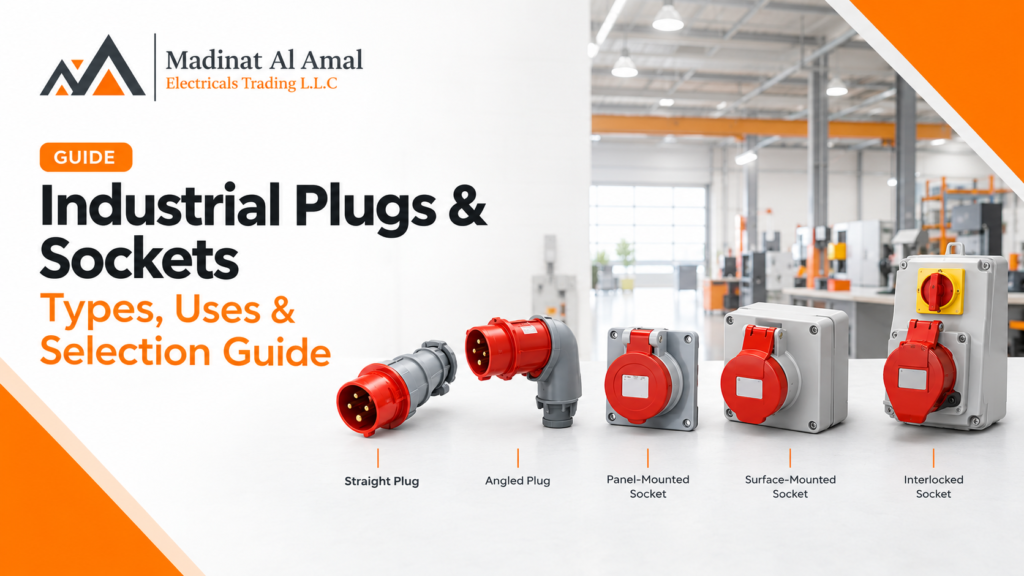
1. Straight Industrial Plugs and Sockets
Straight plugs and sockets are among the commonly used configurations for industrial electrical connections. The cable and connection arrangement follows a relatively straightforward form, making them suitable for various equipment and power distribution applications.
They can be used in workshops, factories, temporary installations, and commercial environments depending on their electrical specifications.
2. Panel-Mounted Sockets
Panel-mounted sockets are installed directly onto electrical panels, machinery, distribution boards, or equipment.
They can be useful where a fixed connection point is required rather than a portable socket arrangement. The mounting method should be considered carefully to ensure compatibility with the equipment or enclosure.
3. Surface-Mounted Sockets
Surface-mounted industrial sockets are installed on walls, panels, or other suitable surfaces. They can provide convenient access to electrical connections in workshops, production areas, warehouses, and other facilities.
The installation location and surrounding environment should be evaluated before selecting the appropriate product.
4. Angled Plugs
Angled industrial plugs are designed with the cable entry positioned at an angle. This can be useful where available space, cable routing, or equipment configuration makes a straight cable entry less practical.
The correct design can help with cable positioning and installation requirements.
5. Interlocked Sockets
Interlocked socket systems incorporate mechanisms designed to coordinate the socket with switching or protective functions.
These systems can be useful in applications where controlled connection and disconnection are important. The specific operating mechanism varies according to the product design and application.
6. Low-Voltage Industrial Plugs and Sockets
Some industrial connection systems are designed for specific lower-voltage applications. The voltage rating must always correspond with the requirements of the equipment and electrical installation.
These products should be selected based on the relevant technical specifications rather than appearance alone.
Understanding Current and Voltage Ratings
One of the most important considerations when selecting an industrial plug or socket is its electrical rating.
Current is typically expressed in amperes (A), while voltage is expressed in volts (V). The selected product should be appropriate for the electrical characteristics of the equipment and circuit.
For example, industrial connection products may be available in different current ratings such as 16 A, 32 A, 63 A, or higher ratings. The correct selection depends on the application and electrical design.
A higher-rated product should not automatically be selected simply because it has a larger rating. The complete electrical system, including cable size, protective devices, equipment requirements, and installation conditions, needs to be considered.
Electrical selection and installation should be carried out by qualified professionals in accordance with applicable requirements.
Explore Industrial Electrical Connection Options
Looking for reliable industrial plugs, sockets, and electrical connection products in Dubai? Speak with Madinat Al Amal about options suited to your project requirements.
Make the Right Choice for Your Electrical Project
Selecting industrial connection equipment requires attention to more than size and appearance. Industrial plugs and sockets should be matched with the electrical load, voltage, pole configuration, environmental conditions, cable requirements, and intended application.
For contractors, businesses, and project teams, reviewing these factors before purchasing can make it easier to identify suitable electrical connection products for specific installations.
If you are planning an electrical, commercial, or industrial project and need help exploring suitable products, contact Madinat Al Amal to discuss your requirements and available solutions.
Select the Right Specifications for Your Application
Not sure which industrial plug or socket configuration you need? Madinat Al Amal can help you review the key specifications for your electrical application.
Frequently Asked Questions
What are industrial plugs and sockets used for?
Industrial plugs and sockets are used to connect electrical equipment to power supplies in demanding environments such as factories, workshops, warehouses, construction sites, and commercial facilities.
What is the difference between industrial and domestic plugs?
Industrial plugs are available in a wider range of electrical configurations and may be designed for more demanding applications and environmental conditions. Domestic plugs are generally intended for standard residential and everyday electrical use.
How do I choose an industrial plug and socket?
Consider the equipment’s voltage, current, frequency, pole configuration, cable requirements, installation method, environmental conditions, and required IP rating before selecting a product.
What does an IP rating mean on an industrial socket?
An IP rating indicates the level of protection provided by an enclosure against the ingress of solids and water under defined testing conditions. The appropriate rating depends on the installation environment.
Are industrial plugs and sockets available in different current ratings?
Yes. Industrial connection products are available in different current ratings. The appropriate rating should be selected according to the electrical requirements of the equipment and installation.
Can industrial plugs and sockets be used outdoors?
Some industrial plugs and sockets are designed for outdoor applications, but suitability depends on the product’s specifications, IP rating, environmental conditions, and installation requirements.
Source the Right Industrial Plugs and Sockets
Looking for industrial plugs and sockets for your commercial or industrial project? Connect with Madinat Al Amal to explore suitable electrical connection solutions in Dubai.