When planning a commercial building, lighting is more than just choosing bright fixtures. Proper lighting calculations improve employee productivity, reduce energy costs, enhance safety, and ensure compliance with local building standards. Whether you’re designing an office, warehouse, retail store, hotel, hospital, or educational facility, understanding how to calculate lighting requirements is essential.
Working with an experienced lighting supplier in Dubai helps ensure that your lighting design meets operational requirements while maximizing energy efficiency. In this guide, we’ll explain how lighting calculations work, the factors affecting commercial lighting, and how choosing the right products can improve your project’s long-term performance.
Why Accurate Lighting Calculations Matter for Every Commercial Building
Lighting directly affects how a commercial space functions. Insufficient lighting reduces productivity and creates safety hazards, while excessive lighting increases electricity costs and causes visual discomfort.
Businesses today focus on:
- Energy-efficient lighting
- Better employee productivity
- Lower maintenance costs
- Uniform illumination
- Compliance with local regulations
- Sustainable building practices
Whether you’re sourcing products from a trusted lighting supplier in Dubai or planning a complete lighting upgrade, calculating the right lighting levels should always be the first step.
As one of the trusted names in electrical and lighting solutions, Madinat Al Amal helps contractors, facility managers, and project consultants choose reliable lighting products tailored to commercial requirements.
Build Every Project with Trusted Electrical Supplies
Partner with Madinat Al Amal for genuine electrical products, reliable stock availability, and expert support that keeps your projects on schedule.
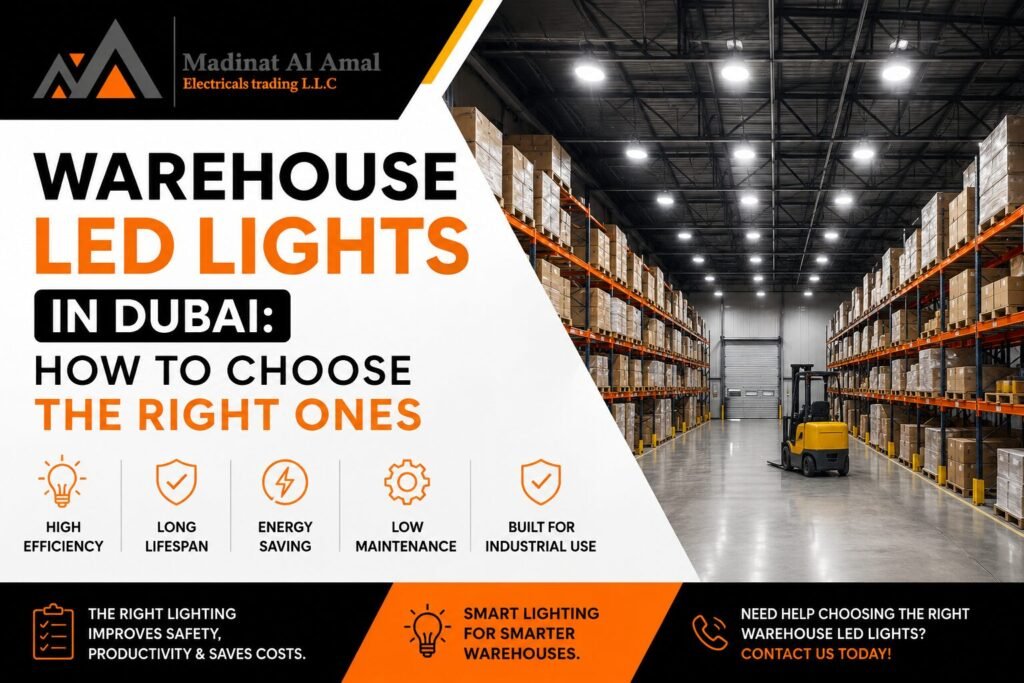
Best LED Lighting Solutions for Warehouses in Dubai
Different areas of a warehouse can require different lighting approaches. A high-ceiling storage area, for example, may need a completely different fixture from an office, loading dock, or emergency exit route.
Warehouse Area | Recommended LED Solution | Main Consideration |
High storage areas | LED high-bay lights | Mounting height and beam distribution |
Storage aisles | Linear LED or aisle lighting | Uniform illumination |
Loading bays | LED high bays or floodlights | Visibility and durability |
Packing areas | Linear LED fixtures | Consistent task lighting |
Corridors | LED battens or linear fixtures | Efficient directional illumination |
Emergency routes | Emergency LED lighting | Safety and visibility |
Outdoor warehouse areas | LED floodlights | Weather resistance and coverage |
Offices inside warehouses | LED panels | Visual comfort and uniformity |
The most effective solution is usually a combination of LED fixtures, rather than installing one type of light throughout the entire facility.
1. LED High-Bay Lighting for Large Warehouses
Why high-bay LED lighting works well for high ceilings
LED high-bay lights are one of the most common solutions for warehouses with high ceilings. They are designed to provide substantial illumination from elevated mounting positions.
High-bay lighting can be particularly useful for:
- Distribution centres
- Logistics warehouses
- Manufacturing facilities
- Large storage facilities
- Industrial workshops
- Fulfilment centres
The fixture’s beam angle is particularly important. A narrow beam can help concentrate light over specific areas, while a wider beam can provide broader coverage.
Instead of simply selecting the highest-wattage fixture available, warehouse operators should consider the relationship between:
Mounting height + lumen output + beam angle + fixture spacing + required illumination level.
A professional lighting layout can help determine how many fixtures are required and where they should be positioned.
2. Linear LED Lighting for Warehouse Aisles
Linear LED fixtures can be useful where warehouses contain long aisles, shelving systems, or defined work areas.
Their elongated design can distribute light along the length of an aisle and reduce unnecessary illumination in areas that do not require it.
Linear LED lighting may be suitable for:
- Narrow warehouse aisles
- Picking areas
- Packing stations
- Work benches
- Production areas
- Storage corridors
For facilities with tall shelving, lighting should be positioned carefully to minimise shadows created by racks and stored goods.
Choose an Authorized Electrical Supplier You Can Trust
Avoid costly delays and counterfeit products. Source certified electrical materials from a trusted supplier serving contractors across Dubai.
3. LED Floodlights for Loading and Outdoor Areas
Warehouses often include external areas such as loading docks, parking spaces, access roads, and storage yards.
These areas may require LED floodlights rather than indoor high-bay fixtures.
A suitable outdoor lighting system should consider:
- Required coverage
- Mounting position
- Weather exposure
- Beam angle
- Glare
- Colour temperature
- Protection rating
- Vehicle and pedestrian movement
For outdoor warehouse environments, selecting fixtures with an appropriate IP rating can help protect lighting equipment from dust and moisture.
4. Smart LED Lighting with Motion and Occupancy Sensors
Not every part of a warehouse is occupied continuously. Installing sensors can therefore help reduce unnecessary operating hours.
Motion or occupancy-based lighting can be particularly useful in:
- Low-traffic aisles
- Storage rooms
- Secondary corridors
- Utility areas
- Staff-only spaces
A smart lighting system can be configured so that lights remain at a lower output or switch off when an area is unoccupied, depending on the system design.
However, sensors should be positioned carefully. False triggers, delayed activation, or inadequate sensor coverage can negatively affect the user experience.
5. Emergency LED Lighting for Warehouse Safety
Emergency lighting should not be overlooked when planning warehouse illumination.
In the event of a power interruption, emergency lighting can help occupants identify evacuation routes, exits, stairways, and other important areas.
A warehouse emergency lighting plan may include:
- Emergency exit signs
- Escape-route lighting
- Emergency luminaires
- Stairway lighting
- Fire-exit illumination
Emergency lighting requirements should be considered alongside the applicable building, fire-safety, and electrical regulations rather than treated as an optional addition to the main lighting system.
Power Your Next Project with Genuine Electrical Brands
From leading global manufacturers to dependable technical support, Madinat Al Amal helps contractors deliver quality projects with confidence.
How to Choose the Right LED Lighting for a Warehouse
Choosing warehouse lighting involves more than comparing prices or wattage.
1. Assess the warehouse ceiling height
The mounting height affects the type of fixture and beam distribution required.
Low- and medium-height areas may work well with linear fixtures or LED battens, while taller warehouses often require high-bay solutions.
2. Determine the required illumination level
Different activities require different levels of visibility.
For example, general storage may have different lighting requirements from detailed picking, packing, inspection, or manufacturing tasks.
The lighting design should therefore be based on the activities performed within each zone.
3. Consider lumen output instead of wattage alone
Lumens measure the amount of visible light produced, while watts indicate electrical power consumption.
Two fixtures with the same wattage can produce different amounts of light, which is why lumen output and lighting efficiency should be evaluated together.
4. Check the colour temperature
Warehouse LED lighting is commonly available in different colour temperatures.
The appropriate choice depends on the application, visual environment, and desired appearance.
For industrial and warehouse applications, neutral or cool white lighting is often considered because it can provide a clear working environment.
5. Evaluate colour rendering
Colour Rendering Index (CRI) indicates how accurately a light source reveals colours compared with a reference light source.
Higher CRI can be important in areas where workers need to distinguish product colours, labels, packaging, or components.
6. Consider maintenance access
A lighting fixture installed at significant height can be difficult and costly to maintain.
Long-life LED fixtures can help reduce replacement frequency, but maintenance access should still be considered when designing the installation.
Key Specifications to Compare When Buying Warehouse LED Lighting
When evaluating products from an LED lighting distributor in Dubai, buyers should look beyond the initial purchase price.
Specification | Why It Matters |
Lumens | Indicates light output |
Wattage | Helps assess electrical consumption |
Efficacy | Shows how efficiently electricity is converted into light |
Beam angle | Determines how light is distributed |
Colour temperature | Influences the visual appearance of the light |
CRI | Indicates colour-rendering quality |
IP rating | Important for dusty or moisture-exposed areas |
Lifespan | Helps estimate replacement frequency |
Driver quality | Influences reliability and performance |
Dimming compatibility | Allows lighting output to be controlled |
Sensor compatibility | Supports automated lighting control |
A reliable specification sheet can make product comparison significantly easier.
Need Reliable Electrical Materials for Your Project?
Get competitive pricing, authentic products, and fast availability from one of Dubai’s trusted authorized electrical suppliers.
Why Lighting Layout Matters as Much as the LED Fixture
Even a high-quality LED fixture can perform poorly if it is incorrectly positioned.
Warehouse lighting design should account for:
- Ceiling height
- Aisle width
- Rack height
- Fixture spacing
- Working areas
- Obstructions
- Natural daylight
- Shadows
- Glare
- Emergency routes
For example, placing fixtures directly above tall shelving may not always provide the best illumination at floor level. Similarly, excessive light output in one area can create uneven illumination across the warehouse.
This is why lighting calculations and layout planning are important before finalising the installation.
Energy Efficiency: Looking Beyond LED Wattage
One of the major advantages of LED warehouse lighting is energy efficiency, but actual energy savings depend on how the entire lighting system is designed and operated.
Businesses should consider:
Energy consumption = Fixture wattage × Number of fixtures × Operating hours
Sensors, dimming controls, daylight integration, and efficient fixture selection can potentially reduce operating hours or light output when full illumination is unnecessary.
For a large warehouse operating multiple shifts, even relatively small improvements in lighting efficiency can become significant over time.
What Should Businesses Look for in an LED Lighting Supplier in Deira?
For businesses sourcing electrical and lighting products locally, supplier evaluation should focus on product suitability and supply reliability rather than price alone.
A suitable LED lighting supplier in Deira should be able to provide clear product specifications and help buyers understand differences between available lighting solutions.
Before placing a bulk order, consider asking about:
- Product datasheets
- Lumen output
- Beam angles
- Warranty terms
- Driver specifications
- IP ratings
- Available stock
- Product certifications
- Recommended applications
- Replacement availability
For larger projects, it can also be useful to request samples or technical information before purchasing the complete quantity.
Businesses looking to understand the product range available from Madinat Al Amal can review the company’s electrical and lighting solutions before discussing specific requirements.
Let's Help You Complete Your Project Without Delays
Contact Madinat Al Amal today for expert product recommendations, quick quotations, and dependable electrical supply solutions tailored to your project needs.
How to Compare LED Lighting Options for a Warehouse
A practical comparison should consider both performance and long-term operating requirements.
Factor | Basic Evaluation | Better Approach |
Price | Lowest purchase cost | Total cost of ownership |
Wattage | Lower wattage | Lower wattage with adequate lumen output |
Brightness | High brightness | Correct illumination for the task |
Lifespan | Manufacturer claim | Lifespan + operating conditions |
Installation | Fixture cost | Fixture + installation + maintenance |
Controls | Manual switching | Sensors/dimming where appropriate |
Maintenance | Replacement cost | Accessibility and replacement frequency |
This approach can help prevent the common mistake of choosing lighting based solely on the cheapest upfront price.
Common Mistakes to Avoid When Selecting Warehouse LED Lighting
Warehouse operators can encounter several problems when lighting is selected without proper planning.
Avoid choosing fixtures based only on wattage
A low-wattage fixture is not automatically the best option. Compare lumen output and efficacy as well.
Avoid installing the same fixture everywhere
Storage aisles, loading docks, offices, and outdoor areas have different lighting requirements.
Avoid ignoring glare
Excessive glare can make it harder for workers to see labels, equipment, or moving vehicles comfortably.
Avoid overlooking the lighting layout
The right fixtures can still create dark spots if spacing and positioning are not properly planned.
Avoid focusing only on purchase price
A cheaper fixture may have higher maintenance requirements or lower performance over its operating life.
Your Trusted Electrical Supply Partner in Dubai
From planning to project completion, count on Madinat Al Amal for authentic products and dependable service.
Frequently Asked Questions About Warehouse LED Lighting
1. What is the best LED lighting for a warehouse?
LED high-bay lighting is commonly suitable for warehouses with high ceilings, while linear LED fixtures can work well in aisles, packing areas, and workstations. The best option depends on ceiling height, warehouse layout, required illumination, and the activities performed in each area.
2. How many LED lights does a warehouse need?
There is no universal number. The required quantity depends on the warehouse dimensions, mounting height, lumen output, beam angle, fixture spacing, required illumination level, shelving configuration, and the intended use of each area. A lighting layout or photometric calculation provides a more accurate estimate.
3. Are LED high-bay lights suitable for high ceilings?
Yes. LED high-bay fixtures are specifically designed for applications where luminaires are mounted at greater heights. The appropriate beam angle and lumen output should be selected according to the mounting height and floor layout.
4. What colour temperature is suitable for warehouse lighting?
Neutral and cool white LED lighting are commonly considered for warehouses because they can provide a clear working environment. The appropriate colour temperature ultimately depends on the application, visual requirements, and overall lighting design.
5. Can motion sensors be used with warehouse LED lights?
Yes. Many LED lighting systems can be integrated with occupancy or motion sensors. They can be particularly useful in low-traffic areas where lights do not need to operate at full output continuously.
6. What should I check before buying warehouse LED lights?
Check the lumen output, wattage, efficacy, beam angle, colour temperature, CRI, IP rating, lifespan, driver specifications, warranty, certifications, and compatibility with controls. Also consider the warehouse’s ceiling height and lighting layout before selecting fixtures.
Conclusion: Choosing the Right LED Lighting System for Your Warehouse
The best LED lighting solution for a warehouse is not necessarily the brightest or cheapest fixture. It is the system that provides appropriate illumination, efficient energy use, reliable performance, manageable maintenance, and suitable coverage for the facility’s specific layout.
High-bay lights can be effective for high-ceiling storage areas, linear LEDs can work well along aisles and workstations, floodlights can support outdoor operations, and smart controls can help manage lighting in low-occupancy areas.
For businesses comparing products or looking for an experienced LED lighting supplier in Dubai, it is worth evaluating product specifications, technical support, stock availability, and suitability for the intended application.
Madinat Al Amal provides electrical and lighting products for commercial and industrial requirements in Dubai. You can explore its LED lighting solutions to review available options, or contact Madinat Al Amal to discuss your warehouse lighting requirements and product availability.