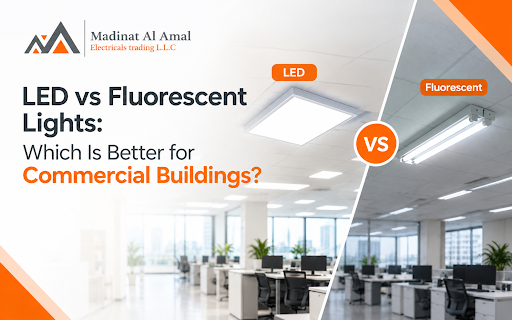
Choosing the right lighting system can have a direct impact on a commercial building’s electricity consumption, maintenance requirements, lighting quality, and operating costs. This is why the comparison between LED vs fluorescent lights remains important for offices, retail stores, warehouses, hotels, and other commercial spaces.
LED lighting has become a widely used option for commercial applications because modern LED fixtures can provide high light output with comparatively low power consumption and can work with dimming, occupancy sensors, and other lighting controls. Fluorescent lighting, meanwhile, remains present in many existing buildings, particularly those using older linear fluorescent fixtures.
So, should a commercial building continue using fluorescent lighting or switch to LED?
The answer depends on the existing system, operating hours, lighting requirements, and upgrade costs. However, for many commercial lighting upgrades, LED technology offers advantages in energy efficiency, maintenance, controllability, and fixture design.
LED vs Fluorescent Lights: What Is the Difference?
LED and fluorescent lighting produce light using different technologies.
LED stands for light-emitting diode. LEDs generate light through semiconductor technology and are available in lamps and complete fixtures designed for a wide range of commercial applications.
Fluorescent lighting uses an electric discharge through a gas-filled tube to produce ultraviolet radiation, which interacts with a phosphor coating to create visible light. Fluorescent systems also use a ballast as part of the lighting system.
The practical difference for a commercial building comes down to more than the lamp itself. The complete system – including the fixture, driver or ballast, controls, light output, and operating schedule – affects energy use and performance. When planning a commercial lighting upgrade, an LED light service provider can also help assess these requirements and identify suitable lighting options. Madinat Al Amal suppl
Which one uses less energy?
In many commercial applications, a properly designed LED system can use less electricity than an older fluorescent system while delivering the required light output.
However, comparing wattage alone is not enough. A better comparison is lumens per watt (lm/W), which measures how much light a lighting product produces for each watt of electricity consumed. DOE commercial LED guidance uses luminous efficacy as a key efficiency measure.
How Energy Efficient Are LED Lights Compared With Fluorescent Lighting?
For commercial buildings, energy efficiency is one of the main reasons businesses consider moving from fluorescent to LED lighting.
LED fixtures can provide high light output while using less power than many older lighting systems. ENERGY STAR specifically identifies replacing older inefficient lighting with efficient LED systems as a commercial energy-saving opportunity.
However, the actual savings will depend on factors such as:
- Existing fluorescent lamp wattage
- Ballast power consumption
- Number of fixtures
- Daily operating hours
- LED fixture efficiency
- Required light levels
- Lighting controls
- Operating schedule
DOE and Better Buildings guidance shows that fluorescent-to-LED retrofit projects can achieve meaningful energy savings, but the result varies by the equipment and retrofit approach selected.
Why shouldn’t you compare only the wattage?
A 20W LED and a 20W fluorescent lamp do not necessarily provide the same useful light.
For a commercial project, the comparison should consider:
Power consumption + light output + distribution + operating hours + controls
This provides a more accurate picture of the potential energy performance.
Which Has a Longer Lifespan: LED or Fluorescent?
LED systems generally offer a longer useful life than many fluorescent lighting products, although the exact rated life depends on the product.
ENERGY STAR explains that LED lifetime is commonly based on lumen maintenance rather than simply waiting for the light source to stop working. In other words, an LED can gradually produce less light over time rather than suddenly failing like a conventional lamp.
For comparison, ENERGY STAR’s commercial lighting guidance lists full-size fluorescent lamps in ranges such as approximately 20,000–30,000 hours for selected T5 and high-performance T8 products, while LED products can have substantially longer rated useful lives depending on the fixture and specification.
Choose the Right Electrical Switch for Your Project
Need help choosing the right switch type, design, or electrical specifications? Talk to Madinat Al Amal for suitable electrical switch options in Dubai.
What does a longer lighting lifespan mean for a business?
It can mean fewer lamp replacements and less time spent accessing fixtures.
This can be particularly relevant in:
- Warehouses with high ceilings
- Large offices
- Retail stores
- Hotels
- Industrial facilities
- Commercial corridors
- Buildings with long operating hours
For these spaces, maintenance access can be a significant part of the overall cost of operating a lighting system.
Does LED Lighting Reduce Commercial Maintenance?
Yes, LED upgrades can reduce some routine lighting maintenance requirements, particularly when replacing older fluorescent lamps and associated components.
Fluorescent systems may require lamp replacement and ballast-related maintenance over time. LED fixtures generally have longer useful lives and can reduce the frequency of routine light-source replacement.
ENERGY STAR notes that commercial LED upgrades can reduce operations and maintenance requirements because of their longer service life.
Is LED lighting better for buildings with difficult-to-reach fixtures?
It can be particularly useful in applications where replacing lamps is difficult or expensive.
For example, replacing lamps in a high-bay warehouse may require lifting equipment or specialist access. A longer-life lighting system can reduce the frequency of these maintenance interventions.
The actual maintenance benefit still depends on the quality of the LED product, installation, operating conditions, and fixture design.
Is LED Lighting More Expensive Than Fluorescent Lighting?
The answer depends on whether you are comparing the initial purchase price or the total cost of ownership.
Fluorescent lamps can have a lower upfront replacement cost in some situations, particularly where an existing fluorescent fixture is already installed.
An LED upgrade may require a higher initial investment, especially if the project involves replacing complete fixtures rather than simply replacing lamps.
However, the long-term cost can also include:
- Electricity consumption
- Lamp replacements
- Ballast maintenance
- Labour
- Access equipment
- Disposal
- Downtime
- Lighting controls
For this reason, commercial lighting decisions should consider the full operating cost rather than the purchase price alone.
Can LED lighting pay for itself?
It can, but there is no universal payback period.
The payback depends on the number of fixtures, existing wattage, LED wattage, electricity rates, operating hours, maintenance costs, installation costs, and available controls.
A facility manager can estimate the potential payback by comparing the existing annual lighting cost with the projected cost after the upgrade.
What Should You Consider Before Replacing Fluorescent Lights With LEDs?
Before starting a commercial lighting upgrade, don’t simply count the existing fluorescent tubes and order LED replacements.
First evaluate:
1. Existing Fixture Type
Identify whether the building uses:
- T5 fixtures
- T8 fixtures
- T12 fixtures
- Fluorescent troffers
- High-bay fixtures
- Other fluorescent systems
The existing fixture affects the available upgrade options.
2. Required Light Output
Determine how much light the space actually requires.
The goal should not be to install the highest-wattage LED available. The objective is to provide appropriate illumination efficiently.
3. Operating Hours
A building operating 12–24 hours a day may have a different financial case for an LED upgrade than a space used for only a few hours each day.
4. Lighting Controls
Modern commercial LED systems can work with controls such as occupancy sensors, dimming, and other automated strategies. DOE notes that these control strategies can provide additional energy-saving opportunities where appropriate.
5. Installation Method
The project may involve:
- LED replacement lamps
- Retrofit kits
- Complete LED luminaires
DOE’s Better Buildings program specifically identifies these as different retrofit approaches for fluorescent troffer systems
Find the Right Electrical Switch Solution
Explore electrical switch options designed for different residential, commercial, and industrial applications, control requirements, and installation needs.
Should You Replace All Fluorescent Lights With LED at Once?
Not necessarily.
A phased upgrade can sometimes make sense, particularly for large commercial properties.
A business could begin with areas that:
- Operate for the longest hours
- Have high maintenance requirements
- Use older fluorescent systems
- Have difficult-to-access fixtures
- Have higher lighting energy consumption
The results from an initial phase can then help inform subsequent upgrades.
For larger fluorescent-to-LED projects, DOE guidance recommends evaluating retrofit options and considering both the lighting technology and associated controls rather than treating the upgrade as a simple lamp replacement.
How to Compare LED and Fluorescent Lighting for Your Building
Factor | LED Lighting | Fluorescent Lighting |
Energy efficiency | Generally high, depending on product | Varies by lamp and ballast |
Useful life | Generally longer | Generally shorter than many LED systems |
Maintenance | Lower replacement frequency can be possible | More frequent lamp/ballast maintenance may be required |
Controls | Supports many modern control strategies | Control options depend on system |
Initial cost | Can be higher for a complete upgrade | Existing systems may have lower replacement cost |
Mercury | Does not use mercury as fluorescent lamps do | Many fluorescent lamps contain mercury |
Retrofit options | Replacement lamps, retrofit kits, complete luminaires | Existing fluorescent systems |
Best comparison method | Lumens, efficacy, controls, total operating cost | Lamp + ballast + fixture performance |
The actual performance depends on the specific products and installation, so these characteristics should be treated as a project-level comparison rather than a universal specification.
Which Is Better for Commercial Buildings: LED or Fluorescent?
For many commercial lighting upgrades, LED technology can provide advantages in energy efficiency, useful life, maintenance, and control options.
However, the right decision depends on the existing fluorescent system, project budget, operating hours, lighting requirements, and the type of LED solution being considered.
A properly planned upgrade should compare the complete lighting system rather than simply comparing the price of one fluorescent tube with one LED lamp.
Planning an Electrical Switch Installation?
Get the right switch solution for your project requirements. Contact Madinat Al Amal for electrical switch options in Dubai.
How Madinat Al Amal Can Help You Choose the Right Lighting Solution
Madinat Al Amal can be considered when reviewing electrical product requirements for commercial and industrial projects.
Before selecting a lighting solution, businesses should have their application, required light output, fixture type, operating conditions, and project quantity clearly defined.
If you are planning a commercial lighting upgrade, discuss your requirements with the supplier before finalising the products. This can help ensure that the selected solution is suitable for the building and intended application.
Ready to Upgrade Your Commercial Lighting?
If your commercial property still relies on fluorescent lighting, now is a good time to evaluate whether an LED upgrade could improve energy performance, maintenance requirements, and lighting control.
Contact Madinat Al Amal to discuss your project requirements and explore suitable commercial lighting solutions for your building.
Simplify Your Electrical Switch Selection
From switch type and control requirements to electrical specifications and design, choose a switch that fits your project’s needs.
Frequently Asked Questions
1. Are LED lights more energy-efficient than fluorescent lights?
Yes, LED lights generally use less electricity than older fluorescent systems.
2. Do LED lights last longer than fluorescent lights?
Yes, LED lighting generally has a longer useful life than fluorescent lighting.
3. Can LED lights reduce commercial maintenance costs?
Yes, LEDs can reduce lamp replacement and ballast-related maintenance.
4. Are LED lights more expensive than fluorescent lights?
LED upgrades can have a higher initial cost, but total operating costs may be lower.
5. Can fluorescent lights be replaced with LED lights?
Yes, businesses can use LED replacement lamps, retrofit kits, or complete LED fixtures.
6. Are LED lights suitable for commercial buildings?
Yes, LEDs can be suitable for offices, warehouses, retail stores, hotels, and other commercial spaces, depending on the project’s lighting requirements.
Need Electrical Switches in Dubai?
Discuss your project requirements with Madinat Al Amal and explore suitable floor box solutions for commercial installations.