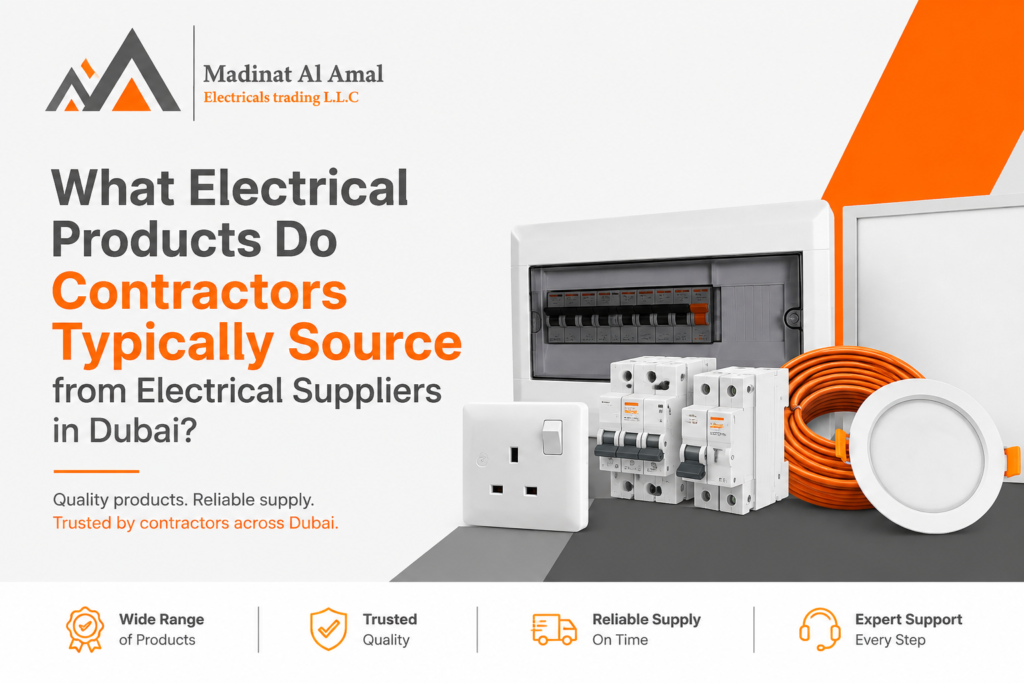
Contractors working on commercial, residential, industrial and MEP projects rarely source just one type of electrical product. A typical procurement requirement can include cables, circuit breakers, switches, sockets, distribution boards, lighting equipment, industrial plugs, floor boxes, enclosures and other project-specific components.
For contractors, choosing the right electrical suppliers in Dubai is therefore about more than product availability. The supplier needs to provide products that match the required specifications, quantities, compatibility requirements and project standards.
This guide explains the main electrical product categories contractors typically source, what to check before ordering and how procurement decisions can affect installation and project execution.
What Electrical Products Do Contractors Usually Source in Dubai?
Contractors typically source a combination of electrical distribution, wiring, connection, protection, control and lighting products.
The most common categories include:
Product Category | Typical Application | Key Factors to Check |
Switches and sockets | Offices, buildings and commercial spaces | Type, rating, configuration and finish |
Circuit breakers | Protection of electrical circuits | Current rating, breaking capacity and compatibility |
Distribution boards | Electrical distribution | Capacity, configuration and enclosure requirements |
Cables | Power and electrical connections | Size, conductor type, insulation and application |
Industrial plugs and sockets | Industrial and commercial connections | Current rating, poles, ingress protection and application |
Floor boxes | Floor-level power/data access | Size, configuration, finish and installation requirements |
Lighting | Offices, warehouses and commercial areas | Lighting type, output, application and installation |
Wiring accessories | Electrical installation | Compatibility, type and project requirements |
Protection devices | Electrical safety and circuit protection | Device type, rating and system compatibility |
Electrical enclosures | Housing and protecting equipment | Dimensions, material and environmental requirements |
Project-specific components | Specialized installations | Drawings, specifications and compatibility |
The exact product mix varies according to the project. An office fit-out, warehouse, hotel, factory and residential development can have very different electrical procurement requirements.
Looking for Reliable Electrical Products in Dubai?
Source switches, sockets, circuit protection, cables, lighting, industrial electrical products, and more from Madinat Al Amal—your trusted electrical supplier in Dubai.
1. Switches and Sockets
Switches and sockets are among the most frequently sourced wiring accessories for building projects.
Contractors may require different configurations depending on the application, including standard switches, socket outlets and other compatible accessories.
What contractors check before buying switches and sockets
Important considerations include:
- Number and type of outlets required
- Electrical rating
- Configuration
- Compatibility with the installation
- Mounting requirements
- Material and finish
- Project design requirements
- Required quantity
For commercial projects, contractors usually need to coordinate switches and sockets with the architectural and electrical design. The appearance may also matter in finished areas such as offices, hotels and retail environments.
2. Circuit Breakers
Circuit breakers are used to protect electrical circuits from conditions such as overloads and short circuits.
When sourcing breakers, contractors need to match the device to the electrical system and project requirements rather than selecting products based solely on physical appearance or price.
Key specifications to verify
Before procurement, contractors should review:
- Current rating
- Number of poles
- Breaking capacity
- Voltage requirements
- Breaker type
- Mounting arrangement
- Compatibility with the distribution board
- Project specifications
Incorrect selection can create compatibility problems during installation, which is why circuit protection should be treated as a technical procurement requirement.
3. Distribution Boards
Distribution boards provide a central point for distributing electrical power to different circuits within a building or installation.
They are commonly required for commercial buildings, offices, industrial facilities and other projects involving multiple electrical circuits.
What should contractors consider?
Contractors generally need to evaluate:
- Number of outgoing circuits
- Required board capacity
- Breaker configuration
- Available installation space
- Enclosure requirements
- Incoming and outgoing cable arrangements
- Compatibility with selected protection devices
- Project drawings and specifications
The distribution board should be planned as part of the overall electrical system rather than selected independently from the breakers and other protective equipment.
4. Electrical Cables
Cables are another major procurement category for contractors. They can represent a substantial part of the electrical material requirement on a project because different circuits and applications may require different cable specifications.
What do contractors check when sourcing cables?
The selection normally depends on factors such as:
- Cable size
- Conductor type
- Insulation
- Number of cores
- Voltage requirements
- Installation environment
- Circuit requirements
- Applicable project specifications
- Required quantity and cable length
Cable requirements should be established from the project’s electrical design and installation requirements. Ordering the wrong cable specification can result in delays, additional procurement and installation complications.
This is why contractors often provide detailed material schedules or specifications when requesting quotations from electrical material suppliers.
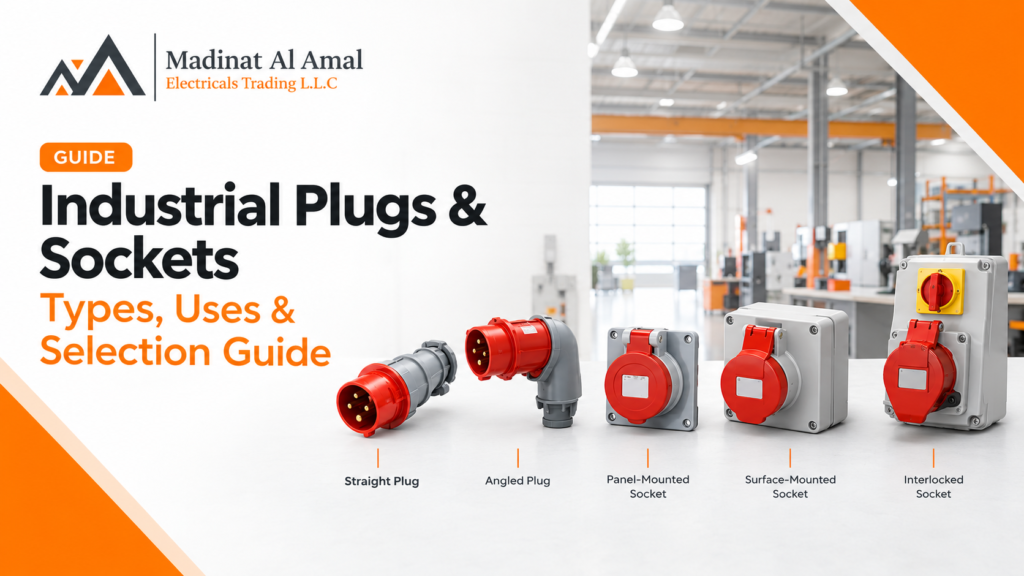
5. Industrial Plugs and Sockets
Industrial plugs and sockets are designed for applications where electrical connections need to suit commercial or industrial environments.
They can be relevant to factories, workshops, warehouses, machinery installations and other applications where standard domestic outlets may not be appropriate.
Important selection factors
Contractors should check:
- Current rating
- Voltage
- Number of poles
- Plug or socket configuration
- Ingress protection requirements
- Mounting arrangement
- Application environment
- Compatibility with the connected equipment
The operating environment is particularly important. A product intended for a specific industrial application should be selected according to the requirements of the installation.
Build Better Projects with the Right Electrical Products
From project essentials to specialized electrical equipment, get quality products and dependable supply support for your next project in Dubai.
6. Floor Boxes
Floor boxes provide convenient access to power and, depending on the configuration, other services at floor level.
They are commonly considered for offices, commercial spaces, meeting areas and other environments where electrical access needs to be integrated into the floor.
Contractors selecting floor boxes should consider:
- Box dimensions
- Number of modules
- Socket configuration
- Required services
- Floor construction
- Cover design
- Installation method
- Load and usage requirements
- Compatibility with accessories
The correct floor box needs to work with both the electrical accessories and the physical floor installation.
For contractors working on office and commercial projects, reviewing the complete floor box configuration before procurement can help avoid installation issues later.
7. Lighting Products
Lighting is another significant category sourced through electrical suppliers in Dubai.
Contractors may procure lighting products for offices, warehouses, commercial buildings, industrial facilities, retail environments and other applications.
The appropriate lighting equipment depends heavily on the intended space and lighting requirements.
Factors contractors consider when sourcing lighting
These can include:
- Type of lighting
- Application
- Required light output
- Installation method
- Fixture dimensions
- Energy requirements
- Control requirements
- Environmental conditions
- Project design
- Quantity
For example, lighting requirements for a warehouse can differ considerably from those of an office or retail environment. Contractors therefore need to consider the intended application before finalizing product specifications.
8. Wiring Accessories
Wiring accessories include the smaller components required to complete electrical installations.
Depending on the project, contractors may source accessories such as switches, sockets, connectors and other installation components.
These products may appear relatively simple, but compatibility is important. Accessories should work with the relevant electrical equipment and installation method.
Procurement considerations
Contractors should check:
- Product type
- Dimensions
- Ratings
- Compatibility
- Mounting method
- Required quantity
- Finish where visible
- Project specifications
Buying accessories separately without checking system compatibility can create problems during installation.
9. Protection Devices
Electrical protection involves more than circuit breakers. Depending on the system and project requirements, contractors may need additional protection devices.
The selection should be based on the electrical design, system characteristics and required level of protection.
Before procurement, contractors should confirm:
- Device type
- Rating
- Application
- Compatibility
- Installation arrangement
- Required quantity
- Project specifications
Protection products should not be selected solely according to price. Technical suitability is a fundamental part of the procurement decision.
10. Electrical Enclosures
Electrical enclosures are used to house and protect electrical equipment and components.
Their requirements can vary considerably depending on where they will be installed.
What should contractors check?
Important considerations include:
- Dimensions
- Material
- Mounting method
- Environmental conditions
- Required ingress protection
- Equipment to be housed
- Access requirements
- Project specifications
An enclosure that is technically unsuitable for the installation environment may not provide the required protection for the equipment inside it.
11. Project-Specific Electrical Components
Not every electrical requirement fits neatly into a standard product category.
Commercial and industrial projects can involve project-specific components selected according to equipment, drawings, specifications and installation requirements.
These may include specialized accessories, connection components, control-related equipment or other products required for a particular system.
For such purchases, contractors typically need to provide electrical suppliers with clear technical information before requesting a quotation.
Useful information can include:
- Product description
- Technical specifications
- Required quantity
- Drawings
- Model or part number
- Installation requirements
- Required delivery timeline
- Applicable project standards
Providing accurate information at the quotation stage makes it easier to identify suitable products.
One Supplier. A Complete Range of Electrical Products.
Simplify your procurement with access to trusted electrical brands and products for commercial, residential, MEP, and industrial projects.
How Do Contractors Choose Between Different Electrical Products?
The cheapest product is not necessarily the most appropriate product for a project.
Contractors generally need to balance technical suitability, compatibility, quantity, availability, quality and procurement requirements.
1. Application
The first consideration is where and how the product will be used.
A product suitable for an office may not be appropriate for an industrial environment. The intended application should therefore guide the initial selection.
2. Technical Specifications
The product needs to meet the project’s required specifications.
Depending on the product category, this can include ratings, dimensions, configuration, materials, installation method and environmental requirements.
3. Compatibility
Products rarely operate in isolation.
A circuit breaker must work with the relevant distribution board. A floor box needs to accommodate the required accessories. Industrial plugs and sockets need to match the connected equipment.
Checking compatibility before ordering can prevent installation problems.
4. Quantity
Contractors need to calculate the required quantity based on drawings, schedules and site requirements.
For larger projects, procurement may involve multiple product categories and significant quantities, making accurate material schedules particularly important.
5. Certification and Project Requirements
Where a project specifies particular standards, approvals or product requirements, contractors should verify that the selected products meet those requirements.
The relevant documentation should be reviewed before procurement rather than after the products arrive on site.
6. Availability and Lead Time
Product availability can influence procurement decisions, especially when materials are required according to a construction schedule.
Contractors may need to confirm:
- Current availability
- Required quantity
- Expected delivery time
- Alternative compatible products, where permitted
- Availability of replacement or additional quantities
A technically suitable product that cannot be obtained within the project timeline may require procurement planning or an approved alternative.
What Information Should Contractors Give Electrical Suppliers When Requesting a Quote?
A detailed request helps electrical suppliers understand exactly what is required.
Instead of simply asking for “electrical materials,” contractors can provide a structured material list containing:
- Product category
- Product description
- Brand or approved manufacturer, if specified
- Model or part number
- Technical rating
- Required quantity
- Installation/application
- Project specifications
- Required delivery timeline
For complex projects, drawings, BOQs or material schedules can provide additional clarity.
This approach can reduce confusion between similar products and make quotation comparisons easier.
Sourcing Electrical Materials for Your Next Project?
Discuss your project requirements with Madinat Al Amal and find the right electrical products for your specifications, quantities, and application.
Why Product Compatibility Matters in Electrical Procurement
Electrical products form part of interconnected systems. Selecting individual components without considering how they work together can lead to problems during installation.
For example:
- Breakers need to correspond with the distribution arrangement.
- Accessories need to fit the selected installation system.
- Industrial plugs and sockets need to match the intended equipment.
- Floor boxes need to accommodate the required modules.
- Enclosures need to provide suitable space and protection for the equipment installed inside.
For this reason, contractors should evaluate products as part of the complete electrical installation rather than as isolated purchases.
What Should Contractors Look for in Electrical Suppliers in Dubai?
When comparing electrical suppliers in Dubai, contractors can evaluate suppliers based on several practical factors.
Factor | Why It Matters |
Product range | Helps consolidate procurement across multiple categories |
Technical information | Makes product selection easier |
Availability | Supports project scheduling |
Quantity capability | Important for larger project requirements |
Product compatibility | Reduces installation issues |
Documentation | Helps verify specifications and requirements |
Communication | Makes quotation and procurement coordination easier |
Delivery capability | Supports material planning |
Product knowledge | Useful when requirements are technical |
A supplier that understands the technical requirements of electrical products can be more useful to contractors than one that simply offers a large catalogue.
How Can Contractors Make Electrical Procurement More Efficient?
Efficient procurement begins before the quotation stage.
Step 1: Prepare the material schedule
List the products required, including quantities and specifications.
Step 2: Separate products by category
Group cables, breakers, switches, lighting, floor boxes and other products separately. This makes it easier to identify missing requirements.
Step 3: Confirm technical specifications
Review ratings, dimensions, configurations and compatibility requirements before requesting quotations.
Step 4: Compare quotations correctly
Do not compare prices alone. Check whether the quoted products actually match the requested specifications.
Step 5: Confirm availability
Verify that the required quantities can be supplied within the project timeline.
Step 6: Check documentation
Where the project requires specific standards or documentation, confirm these requirements before placing the order.
Step 7: Coordinate delivery with the project schedule
Electrical materials should arrive when they are needed for installation, while avoiding unnecessary site storage where possible.
Where Can Contractors Review Electrical Products and Supplier Information in Dubai?
Contractors looking for a broader overview of available electrical product categories can review the Madinat Al Amal products range.
For businesses that want to understand the supplier behind the product range, the About Us page provides additional company information.
When a project has specific electrical procurement requirements, contractors can also contact Madinat Al Amal with the required product details and quantities.
Need Electrical Products for Your Project in Dubai?
Contact Madinat Al Amal today for expert product recommendations, quick quotations, and dependable electrical supply solutions tailored to your project needs.
FAQs
What electrical products do contractors commonly buy from electrical suppliers in Dubai?
Common categories include switches and sockets, circuit breakers, distribution boards, cables, industrial plugs and sockets, floor boxes, lighting products, wiring accessories, protection devices and electrical enclosures. Project-specific components may also be required.
How do contractors select the right electrical products?
Contractors typically consider the intended application, technical specifications, compatibility, quantity, project requirements, documentation, availability and delivery timeline before making a purchase.
Why is product compatibility important when sourcing electrical materials?
Electrical components often form part of the same system. A product may need to match another component’s configuration, rating, dimensions or installation method. Checking compatibility helps reduce installation problems.
What information should contractors provide when requesting an electrical quotation?
A useful quotation request should include the product description, specifications, model or part number where applicable, required quantity, application, project requirements and expected delivery timeline.
Do contractors buy lighting from electrical suppliers in Dubai?
Yes. Lighting is a common electrical procurement category for commercial, industrial and other building projects. The appropriate lighting products depend on the space, application, installation method and project requirements.
Are floor boxes commonly used in commercial projects?
Floor boxes can be used where power and other services need to be accessible from the floor, particularly in applications such as offices and commercial spaces. Contractors should check the box configuration, dimensions, accessories and installation requirements before ordering.
What should contractors consider besides price when choosing an electrical supplier?
Contractors should also consider product suitability, technical support, availability, quantity capability, documentation, compatibility, delivery requirements and the supplier’s ability to understand project-specific requirements.
Conclusion
Electrical procurement for a construction or MEP project involves far more than purchasing individual components. Contractors may need switches and sockets, circuit breakers, distribution boards, cables, industrial plugs, floor boxes, lighting, wiring accessories, protection devices, enclosures and specialized project components.
The right selection depends on the application’s technical requirements, compatibility, quantity, project specifications and procurement timeline.
For contractors comparing electrical suppliers in Dubai, a practical approach is to prepare a detailed material schedule, verify specifications, confirm compatibility and compare suppliers based on overall suitability rather than price alone.
For project-specific electrical requirements, contractors can review the available product range or contact Madinat Al Amal with their material requirements for further procurement assistance.
Make Electrical Procurement Easier
Save time sourcing project essentials by working with a reliable electrical supplier in Dubai offering a wide range of products under one roof.